

The World Bank estimates suggest that India has only about 4% of the world’s water resources to support its 15% of world population It also adds that only about 35% of India’s agricultural land is irrigated, which mean about 65% of farming depends totally on rain. India is the third largest dam building nation in the world after China and the US, although it has a per capita storage of only 213 cubic meters compared to 6,103 per capita in Russia, 4,733 in Australia, 1,964 in the United States, and 1,111 in China, though reservoirs are not the only remedy.
Is India really a water scarce nation or is it simply that we don’t keep water. In 2015, Tamil Nadu saw one of its worst floods in the century, with many cities included Chennai under several feet of water for days. Still, in the very next year 2016, the state was staring at a water scarcity. No one had any clue or lesson to be learnt. According to Professor Sitharam from the Indian Institute of Science, the fact that the per capita availability of water per year in India is 879 cubic meters and it is a water-scarce nation does not mean that there is shortage of water but there is lack of storage of water or water management. He adds, “It is time we follow countries like Japan that have created multiple sub-surface dams. Unlike a surface dam, water loss by evaporation is minimal in underground dams. In a country like India, where evaporation rates are very high, this can be the game changer.”
Since the water is stored within the aquifer, submergence of land can be avoided. Moreover, there will not be any evaporation loss from the reservoir. Additionally, no siltation takes place in the reservoir and the potential disaster like collapse of dams can be avoided. Reservoir evaporation is a big challenge for water managers with massive amounts of water lost. Mumbai alone loses over 1,500 million litres of water from the lakes to evaporation daily, according to the India Water Portal.
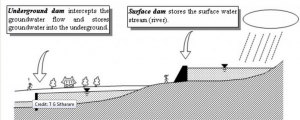
Sitharam also advocates building coastal reservoirs as well. According to him, storing floodwater during rainy season with the help of coastal reservoirs is the best solution to overcome water shortage. The reservoirs should be built near the river mouth where it joins the sea. They should have the provision of capturing only the floodwater and allowing excess floodwater to flow into the sea. Other storage options are also gaining traction like changing the management of existing dams to reflect the changing nature of storms; trapping rainwater in cisterns, ponds, and other small catchments; and increasing the water-holding capacity of the soil.
Dams need not be the behemoth structures that flourished in the last century and continue to be built today. Small dams can slow down rivers that are swollen from a heavy rain, hold back the water, and allow it to soak into the soil. The 2015 Stockholm Water Prize, considered the Nobel for water, went to Rajendra Singh for using such methods to restore groundwater tables in India. Singh’s organization has helped build or inspire the construction of more than 8,600 johads, or small earthen dams, in his home state of Rajasthan in the last two decades.
“Due to the harvesting of rain and recharging groundwater, there is no scope for drought or floods in our area,” according to Singh. “This work of ours is a way to solve both floods and droughts globally. Therefore we believe the impact of this work is on the local level, national level, the international level and above all at the village level.”
No single action will replace the storage that is lost, according to Paul Fleming, manager of the climate and sustainability group at Seattle Public Utilities. That means communities must discuss the menu of options and agree on the order that works for them. He adds “It’s fair to say that any decision on storage needs to be rooted in the values of the location and of the people who reside there, It’s important to think of storage not in isolation but as part of an overall strategy.”
As an example of the impact that water storing can make, take Los Angeles. The City of Los Angeles of California is almost exclusively dependent on imported water for the 12.8 billion liters (3.4 billion gallons) of water it uses each week, according to the city water department. That is where the stormwater plan comes in. The city uses a menu of large- and small-scale projects that help the city capture the little rain that does exist in the arid climate. On the granular level, individual homes are encouraged to purchase rain barrels and cisterns. Entire communities can also take advantage of new initiatives such as community storage basins, underground storage and treatment systems, and water efficiency practices. All told, the techniques included in the plan have the potential to triple the amount of stormwater captured by the city to nearly 200,000 acre feet of water per year, equivalent to more than a third of the city’s current annual water demand.
Though dams are an option, there are several other options too to save precious water from flowing away. While evaporation is a key form of water loss, many urban water storages are located in areas of high evaporation. The use of evaporation reduction techniques has the potential to provide greater security of supply. These techniques include using floating covers or floating objects to act as an impermeable barrier against evaporation, using shade structures to reduce the energy available for evaporation, or using chemical covers of long chain alcohols to form a thin layer on water surface.
We indeed have plenty of water; the problem is we don’t save it unless it matter.
